

- August 19, 2026
- by Editor
- SEO
- 0 Comments
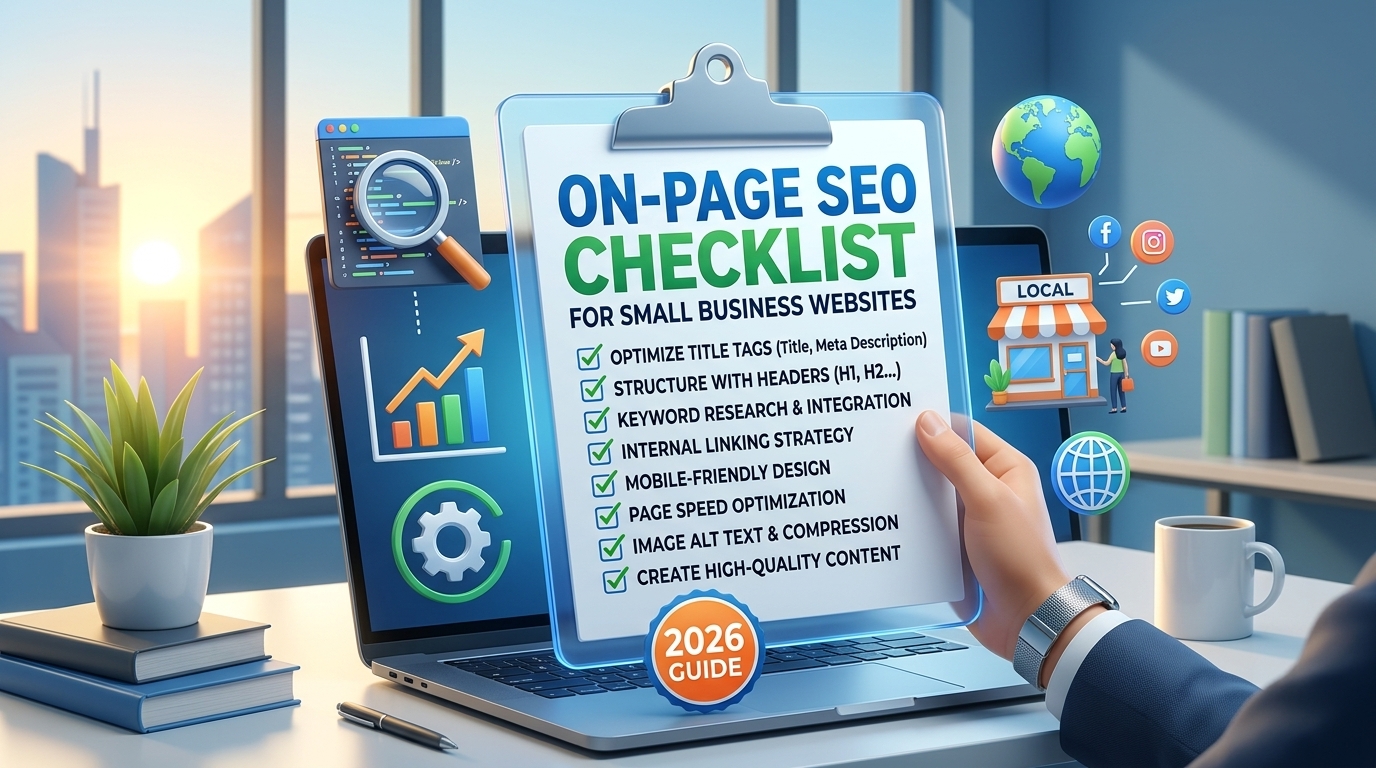
Most SEO checklists you’ll find in 2026 are really two different checklists stitched together: one for ranking in classic Google results, and one for showing up in AI-generated answers. Treating them as the same thing is the single biggest mistake we see small business owners make. This guide separates the two clearly, tells you what to prioritize first, and gives you a working checklist you can act on today — not a 40-item list that leaves you more confused than when you started.
1. Start Here: Know What You’re Actually Competing For
Before optimizing a single page, answer three questions honestly; skipping this step is why most small business SEO efforts go nowhere:
- Is anyone actually searching for what you sell? Pull search volume for your top 10 target terms. If the realistic ceiling is a few hundred monthly searches total, your strategy should look completely different than if it’s tens of thousands.
- What’s your domain’s current standing? A brand-new site competing against decade-old domains on competitive national terms is fighting the wrong battle. Know whether you’re realistically fighting for page one, or fighting just to get indexed and trusted first.
- Local or national intent? If most of your business comes from a defined radius, local SEO (see Section 3) will outperform generic national content every time — and it’s cheaper to win.
Skip this diagnostic, and you’ll spend hours polishing pages that were never going to move the needle for your specific business.
2. Technical Foundations
No amount of good content rescues a slow, broken, or unindexed site.
- Core Web Vitals. Check Largest Contentful Paint (LCP), Interaction to Next Paint (INP), and Cumulative Layout Shift (CLS) in Search Console. Target: LCP under 2.5s, INP under 200ms, CLS under 0.1.
- Mobile-first indexing. Google indexes your mobile site by default — test every important page on an actual phone, not a resized browser window.
- Clean, descriptive URLs.
/on-page-seo-checklist/beats/?p=1234every time — no dates, no random ID strings. - Crawlability. Confirm important pages aren’t accidentally blocked in
robots.txt, and that your XML sitemap is current and submitted. - Indexing status. Run a
site:yourdomain.comsearch periodically to catch pages that silently dropped out of the index. - Site speed on real-world connections. Test with throttled mobile data, not office fiber — a large share of small-business traffic in markets like Pakistan, India, and the Gulf is mobile-first on inconsistent connections.
3. Google Business Profile & Local SEO
If your business serves a specific city or region, this section often outperforms everything else on this list combined — and it’s free.
- Complete every field in your Google Business Profile: accurate name, address, phone, categories, hours, and service areas. An incomplete profile is the most common reason local businesses stay invisible in the map pack.
- NAP consistency. Your Name, Address, and Phone number must match exactly across your website, your GBP, and every directory (Yelp, Facebook, industry listings). Even “St” vs. “Street” can cause ranking confusion.
- Post regularly. Updates, offers, and photos on your GBP keep it active in Google’s eyes and directly influence local visibility.
- Collect and respond to reviews. Naturally-written reviews that mention your services support local rankings, and professional responses build trust for anyone reading them.
- One page per location/service combination. If you serve multiple cities, each city needs its own page with genuinely unique content — local landmarks, service specifics, and neighborhood detail, never the same text swapped with a city name.
4. Content That Satisfies E-E-A-T
Google’s quality guidelines weight Experience, Expertise, Authoritativeness, and Trust (E-E-A-T) heavily — and in 2026 this matters just as much for what AI systems choose to cite.
- Show first-hand experience. Include specifics: client examples (with permission), real numbers, before/after screenshots, or a short embedded case study — not advice generic enough to apply to any business.
- Add author credibility. A byline with a real name and a short bio linking to an About page consistently outperforms “Posted by Admin.”
- Cite sources for factual claims. Linking out to primary data signals rigor — more on why this specifically helps rankings in Section 9.
- Keep content current. Update the publish/modified date when you meaningfully revise a post. Stale advice on a fast-moving topic like SEO loses trust quickly.
5. On-Page Structure and Formatting
- One clear H1 per page that matches search intent exactly — not “SEO Tips” but something specific like “On-Page SEO Checklist for Small Business Websites.”
- Descriptive H2/H3 subheadings. Vague headers like “More Tips” tell search engines and readers nothing; specific ones like “Title Tags, Metadata, and URL Structure” carry real topical signal.
- Lead with the answer. State it in the first 100–200 words, then expand with detail and nuance — this matters even more now that AI Overviews pull directly from early paragraphs.
- Short paragraphs and bullet points improve readability and make your content far easier to extract into snippets or AI answers.
- Comprehensive over thin. One page that fully covers a topic now consistently outperforms five thin pages targeting slight keyword variations of the same idea.
- Accessibility signals matter too. Proper heading hierarchy, alt text, and readable contrast aren’t just for accessibility compliance — they double as clarity signals search engines pick up on.
6. AEO/GEO: Getting Cited by AI, Not Just Ranked by Google
Answer Engine Optimization and Generative Engine Optimization are increasingly treated as their own discipline in 2026, separate from traditional SEO because AI systems weigh signals differently than a ranking algorithm does. A growing share of consumers now use tools like ChatGPT to find local businesses, not just Google.
To be citable by these systems:
- Answer the core question directly and completely within the first couple of sentences of a section. AI extraction favors content where a standalone sentence is the answer.
- Use clear question-and-answer formatting (see the FAQ section below); this is the single easiest format for AI systems to lift and cite.
- Avoid vague, marketing-toned language in favor of factual, specific statements.
- Keep the surrounding context genuinely comprehensive, since AI systems appear to favor pages that demonstrate depth, not just a single quotable sentence surrounded by fluff.
7. Structured Data Checklist
- Article schema for blog content, LocalBusiness schema for your contact/location pages, FAQPage schema for any page with a Q&A section, Review schema where genuine reviews exist.
- Validate before publishing using Google’s Rich Results Test — broken markup is worse than no markup.
- Don’t mark up content that isn’t visible to users — mismatched structured data is a guideline violation, not just a missed opportunity.
8. Internal Linking Strategy
- Link new content back to your cornerstone pages; for example, this checklist links to our complete keyword optimization guide.
- Use descriptive anchor text (“keyword optimization guide,” never “click here”).
- A sensible density is roughly 3–5 internal links per 1,000 words — enough to guide crawlers and readers, not so many it dilutes value.
- If you offer a related service, link to it naturally within the content — a post about backlinks should point to our link building services.
- Fix orphan pages. Every important page should be reachable within 2–3 clicks from your homepage; pages with no internal links pointing to them rarely rank regardless of how good the content is.
- Build topic clusters: one comprehensive pillar page (like this one) surrounded by supporting posts that link back to it and to each other.
9. The Outbound-Link Mistake Most Small Sites Make
Many small business owners avoid linking out to other websites, worried it “leaks” authority or sends visitors away. The evidence doesn’t support that fear. In one controlled experiment, a set of near-identical test sites was split into two groups — one linking out to authoritative external sources, one not — and after several months, every site in the group that linked out ranked higher than its counterpart with no outbound links. The likely explanation: outbound links to credible sources are themselves a trust and relevance signal, similar in spirit to citing sources in academic writing. Practically, this means: when you reference a statistic, a regulation, or a study, link to the source rather than leaving the claim unsupported.
10. Common Mistakes That Quietly Kill Rankings
- Publishing AI-generated content with no human editing or fact-checking — this pattern is now specifically detectable and penalized.
- Buying links from guest-post networks or PBNs — actively penalized rather than simply ignored in 2026.
- Over-optimizing anchor text (the same keyword in every internal or external link).
- Targeting the same keyword with multiple competing pages instead of consolidating into one strong page (keyword cannibalization).
- Treating content publishing as “done” — top-performing pages need review every 6–12 months, not a one-time write-and-forget.
11. Pre-Publish Checklist
- [ ] Title tag under 60 characters, includes primary keyword
- [ ] Meta description under 155 characters, gives a clear reason to click
- [ ] One H1, logical H2/H3 hierarchy
- [ ] Core answer stated within the first 100–200 words
- [ ] At least 2–3 relevant internal links with descriptive anchor text
- [ ] At least 1 outbound link to a credible, relevant source
- [ ] Images compressed, using descriptive file names and alt text
- [ ] Mobile preview checked on an actual device
- [ ] Schema markup added and validated in Rich Results Test
- [ ] NAP details consistent, if this is a local business page
12. Frequently Asked Questions
Q: What is on-page SEO, and how is it different from off-page SEO?
A: On-page SEO covers everything you control directly on your site content, HTML structure, internal linking, and site speed. Off-page SEO covers external signals like backlinks and brand mentions. Both matter, but on-page is where you have full control and should start.
Q: How long should a blog post be in 2026 to rank well?
A: There’s no fixed word count. The real standard is comprehensiveness — cover the topic fully enough that a reader doesn’t need a second page. Competitive topics often land between 1,500–2,500 words; a focused local page can rank at half that if it fully answers the query.
Q: Do I still need to worry about keyword density?
A: No. Modern search engines understand context and synonyms. Focus on naturally covering the topic and its related subtopics rather than repeating an exact phrase a set number of times.
Q: What is AEO/GEO and why should a small business care?
A: Answer Engine Optimization and Generative Engine Optimization refer to structuring content so AI tools like ChatGPT, Gemini, and Google’s AI Overviews can extract and cite it directly. As more people use AI tools instead of typing a search query, showing up there matters as much as ranking in classic results.
Q: Is my Google Business Profile really more important than blog content?
A: For a local business, often yes — at least initially. A complete, consistent GBP with real reviews frequently drives more visibility per hour invested than a new blog post, especially before your site has built up domain authority.
Q: Should I really link out to other websites?
A: Yes. Linking to credible, relevant external sources is a trust signal, not a liability — see Section 9 for the evidence. The key is relevance: link to sources that genuinely support your claim, not just anything with authority.
Q: Is guest posting still safe for SEO in 2026?
A: Selective, editorially reviewed guest posting on genuinely relevant, real-audience sites can still help. Mass guest posting through PBNs or link-selling networks is actively penalized and can hurt your site rather than help it.
Q: How often should I update old blog posts?
A: Review your top-performing and most time-sensitive posts every 6–12 months. Update statistics and examples, and refresh the publish/modified date when the update is substantial.