
- August 12, 2026
- by Editor
- SEO
- 0 Comments
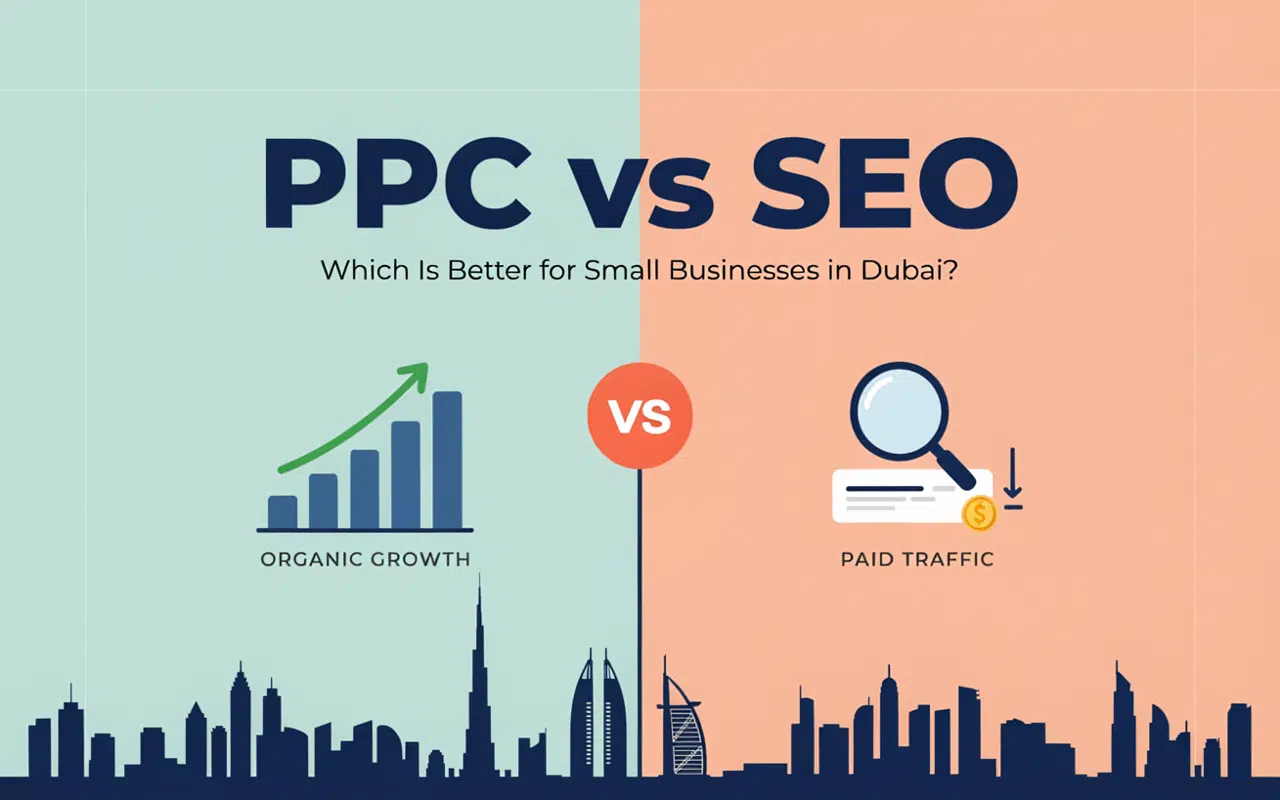
Quick answer: If you need customers fast and have budget to spend now, start with PPC. If you’re building for the long term and can wait a few months for compounding results, prioritize SEO. Most growing businesses eventually need both, but when budget is limited, the right first move depends on your timeline, industry, and cash flow, not a one-size-fits-all rule.
This is one of the most common questions small business owners in Dubai ask before committing their first serious marketing budget, and the honest answer is that it depends less on which channel is “better” in the abstract, and more on what stage your business is at right now.
How PPC Works and Typical Dubai CPC Ranges
Pay-per-click advertising puts your business at the top of Google or social media results almost instantly, and you pay only when someone actually clicks through to your site. In Dubai, cost-per-click varies heavily by industry; competitive sectors like real estate, legal services, and healthcare can see CPCs of AED 15–40 or higher, while less competitive local services might pay closer to AED 3–10 per click.
The advantage is speed: a well-set-up campaign can start driving qualified traffic within a day of launch, which makes PPC especially useful for testing a new offer, filling a slow season, or generating leads while a longer-term SEO strategy builds in the background. The downside is that this traffic stops the moment you stop paying; there’s no residual value carried forward once the budget runs out, unlike content or rankings that continue working on their own.
It’s also worth understanding that PPC performance is heavily dependent on landing page quality, not just the ad itself. A strong ad sending traffic to a slow, confusing, or poorly designed landing page will waste budget regardless of how well-targeted the campaign is; this is one of the most common reasons small businesses conclude “PPC doesn’t work” when the real issue is what happens after the click.
How SEO Works and Realistic Timelines
SEO earns rankings through relevance, content quality, and trust signals built over time — there’s no per-click cost, but there are no instant results either. Most small businesses in Dubai see meaningful movement in rankings within three to six months of consistent, well-executed work, with stronger compounding results typically appearing after six to twelve months as content and authority accumulate.
The payoff is that once you rank for valuable terms, that traffic keeps arriving without an ongoing per-click cost, which makes SEO considerably more sustainable and cost-efficient over a longer time horizon. This is particularly true for informational and comparison-style searches, where a well-optimized page can continue generating qualified visits for years with only periodic updates, unlike a paid campaign that requires continuous funding to sustain the same traffic level.
The tradeoff is patience and consistency — SEO rewards sustained effort over months, and businesses that start and stop investment based on short-term impatience rarely see the compounding benefit that makes the channel valuable in the first place.
Side-by-Side Comparison
| Factor | PPC | SEO |
|---|---|---|
| Speed to results | Immediate (days) | 3–6 months |
| Cost structure | Pay per click, ongoing | Upfront investment, no per-click cost |
| Longevity | Stops when budget stops | Compounds and persists over time |
| Best for | Launches, promotions, testing offers, filling demand gaps | Long-term visibility, brand trust, sustainable lead flow |
| Typical Dubai monthly spend | AED 3,000–15,000+ | AED 1,500–9,000 |
| Risk profile | Lower risk of long-term damage, but budget-dependent | Higher upfront patience required, but durable once achieved |
Decision Framework: 4 Questions to Ask Your Business
1. Do I need customers this week, or can I invest for the next six months? An urgent, immediate need for leads or sales points toward PPC; the ability to be patient for compounding growth points toward prioritizing SEO first.
2. Is my industry highly competitive on Google Ads? If cost-per-click figures are very high in your specific niche, the math may favor investing more heavily in SEO for long-term value rather than continuously paying premium rates for clicks.
3. Do I have a validated offer, or am I still testing what resonates with customers? PPC is considerably faster for testing messaging, pricing, and offers before committing the time and content investment that SEO requires to build around a specific value proposition.
4. What’s my realistic monthly marketing budget? Businesses working with under roughly AED 3,000 per month often see better results concentrating fully on SEO fundamentals rather than spreading an already-thin budget across both channels without properly funding either one.
Can You Do Both on a Small Budget?
Yes — a common and effective approach for Dubai small businesses is running a modest, always-on PPC campaign to generate leads immediately while SEO work builds steadily in the background. Even a small budget of AED 1,500–3,000 per month in paid ads can keep the pipeline moving during the months before SEO gains meaningful traction, at which point budget can gradually shift toward SEO and content as organic traffic picks up and reduces reliance on paid clicks.
This blended approach also has a practical secondary benefit: PPC campaign data (which keywords and ad copy actually drive conversions) can directly inform your SEO content strategy, since you’re seeing real-time evidence of what messaging resonates with paying customers rather than guessing at it from keyword volume alone.
What a Realistic First-Year Timeline Looks Like
For a small business starting from scratch, a practical approach often looks like this: months one through three lean heavily on PPC for immediate lead flow while SEO foundations (technical fixes, Google Business Profile, initial content) are built in parallel. Months four through six typically show the first meaningful SEO traction, at which point it’s worth tracking whether organic leads are starting to reduce your dependency on paid spend for the same volume of inquiries. By months seven through twelve, many businesses find they can either reduce PPC spend while maintaining lead volume through organic growth, or reallocate that saved budget toward scaling SEO further into new keyword territory.
This isn’t a universal timeline — competitive industries and larger target markets will move slower — but it illustrates why treating the PPC-vs-SEO question as either/or often costs businesses momentum they didn’t need to give up. The two channels solve different problems on different timelines, and the businesses that get the most value tend to be the ones that plan for both from the start, even if one is initially funded more heavily than the other.
FAQ
Which is cheaper in the long run, PPC or SEO?
SEO is generally more cost-efficient over a longer time horizon since it doesn’t require ongoing per-click payments, but it demands a larger upfront time and content investment before that efficiency materializes.
Can I stop SEO once I start ranking well?
Not entirely; while SEO is more durable than PPC, rankings still require periodic content updates and maintenance to hold position, especially as competitors continue publishing new content.
Is it a mistake to run PPC and SEO at the same time?
Not necessarily, as long as both are properly funded rather than splitting a limited budget so thin that neither channel gets enough investment to actually perform.
How quickly should I expect to see PPC results?
Traffic and clicks appear immediately, but meaningful conversion data and campaign optimization typically take two to four weeks of active management to stabilize.